
A look behind the scenes at how work is getting done in the CLAA.
The Classical Liberal Arts Academy is engaged in a work of uncommon scope and importance: the construction of a complete course of studies in the classical Catholic tradition. This is not a matter of assembling a few isolated courses, but of building an ordered curriculum that leads the student from the first elements of language and reasoning to the highest studies of philosophy and sacred theology. Such a task requires not only learning and devotion, but also careful organization, lest the work become irregular or incomplete.
For this reason, the Academy has implemented a formal curriculum development system to govern the production of lesson content. This system ensures that the work proceeds in an orderly and dependable manner, so that students and families may rely upon the steady availability of lessons in every course.
Each course in the Academy consists of a large number of individual lessons, often extending into the hundreds. Every lesson must be prepared with attention to several essential elements: the selection of appropriate classical texts, fidelity to the teaching of the Catholic Church, clarity of explanation, and the provision of exercises that cultivate true understanding rather than mere familiarity. When one considers that this work must be carried out across many disciplines—Latin and Greek, grammar and rhetoric, logic and philosophy, theology and more—the magnitude of the undertaking becomes clear. The total number of lessons required for the full program reaches into the thousands.
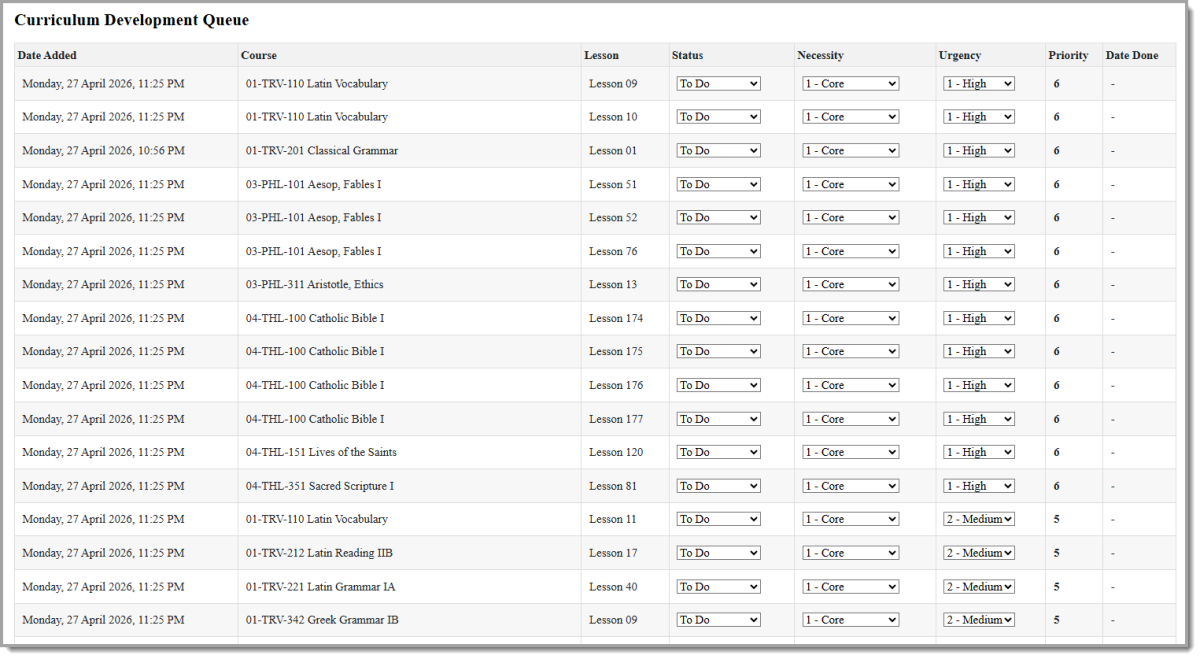
In order to manage this work responsibly, I have created a development queue in which every lesson is tracked individually. Each lesson is assigned a clear status, indicating whether it is yet to be prepared, currently in progress, or completed. In addition, each lesson is evaluated according to its necessity and urgency. This allows the Academy to determine not only what must be done, but what must be done first.
Such prioritization is essential. The Academy is committed above all to the restoration of a truly classical Catholic education. Therefore, the foundational studies—especially those that form the intellect in language, reasoning, and the principles of philosophy and theology—must take precedence. Courses in Latin, logic, and philosophy, for example, are not treated as optional additions, but as core elements of the curriculum. The development system ensures that these essential studies are advanced first, so that students receive what is most necessary for their intellectual and spiritual formation.
At the same time, the system provides continuity within each course. As lessons are completed, the next lesson in sequence is automatically added to the development queue if it does not already exist. In this way, no course is neglected, and progress is always directed forward in an orderly fashion. The work does not proceed randomly, but according to a clear and rational plan.
For families, the benefit of this system is straightforward but significant. It provides confidence that the Academy’s curriculum is not being developed haphazardly, but according to a disciplined and transparent process. Lessons will continue to appear in a steady and predictable manner, and the most important studies will always receive proper attention. The system guards against both delay and disorder, ensuring that the education offered remains coherent and dependable.
Ultimately, this structure serves a higher end. The purpose of the Academy is not merely to deliver content, but to cultivate wisdom in accordance with the classical tradition and the teaching of the Church. Such an end cannot be achieved without order. Just as the intellect proceeds from first principles to conclusions in a rational manner, so too must the curriculum be developed according to right order. The Curriculum Development System is a practical expression of this principle, enabling the Academy to carry forward its work faithfully and effectively for the benefit of all its students.
Mr. William C. Michael, O.P.
Headmaster
Classical Liberal Arts Academy