

Aristotle is the greatest philosopher to ever live, and his ideas have had a profound impact on Catholic thought, particularly in the areas of ethics, politics, and metaphysics. The Classical Liberal Arts Academy recognizes the importance of Aristotle’s works in Catholic education, and places a strong emphasis on the study of his philosophy. In this article, we provide everything you need to know about Aristotle.
Aristotle at a Glance
- Lived: 384–322 BC. Born at Stagira in northern Greece; died at Chalcis.
- Teacher: Plato. Aristotle studied at Plato’s Academy in Athens for about twenty years.
- Student: Alexander the Great, whom he tutored from 343 BC.
- School: Founded the Lyceum in Athens in 335 BC.
- Major works: the Organon (his logical works), Physics, On the Soul, Metaphysics, Nicomachean Ethics, Politics, Rhetoric and Poetics.
- Known for: founding formal logic and giving order to nearly every science. St. Thomas Aquinas called him simply “the Philosopher.”
Aristotle’s Family & Birth
Aristotle, one of the most renowned philosophers and scientists in history, was born in 384 BCE in the ancient Greek city of Stagira. He was the son of Nicomachus, a prominent physician, and Phaestis.
Nicomachus, Aristotle’s father, was a respected doctor who served the king of Macedonia, and his medical expertise was highly valued in the court. Nicomachus came from a distinguished family lineage, and his great-grandfather, also named Nicomachus, was the son of Machaon, who was the son of Asclepius, the Greek god of healing.
Phaestis, Aristotle’s mother, is not as well-known as his father, and not much is known about her background. It is believed that she came from a modest family, but her exact origins are uncertain.
Aristotle’s birthplace, Stagira, was a small town located on the Chalcidice peninsula in northern Greece. The town was known for its strategic location and its proximity to the sea, which made it an important trading center. Although Stagira was not a major city, it was a significant cultural and intellectual center in ancient Greece.

Aristotle’s parents played a significant role in his upbringing and education. Nicomachus, as a physician, would have been highly respected in the community and would have had access to a wide range of intellectual and cultural resources. It is likely that Nicomachus instilled in his son a love for learning and a curiosity about the natural world.
Aristotle was born at a time of great intellectual and cultural development in Greece. This period, known as the Classical Age, was characterized by an explosion of new ideas and innovations in philosophy, science, art, and literature. This era saw the birth of some of the most influential figures in history, including Socrates, Plato, and Aristotle.
Aristotle’s early years were spent in Stagira, where he would have been exposed to a variety of ideas and cultural practices. The town was a melting pot of different cultures and ethnicities, and it is likely that Aristotle was exposed to a wide range of ideas and perspectives.
Despite his modest beginnings, Aristotle would go on to become one of the most influential thinkers in history. His ideas on philosophy, science, and politics have had a lasting impact on Western civilization and continue to shape modern thought.
In conclusion, Aristotle’s parents and birthplace played a significant role in shaping his upbringing and education. Nicomachus, as a prominent physician, would have had access to a wealth of intellectual and cultural resources that would have helped instill in his son a love for learning and a curiosity about the natural world. Aristotle’s birthplace, Stagira, was a small town, but it was a significant cultural and intellectual center in ancient Greece. Aristotle’s exposure to a variety of ideas and cultural practices in his early years would have helped shape his worldview and influence his later ideas and teachings.
Aristotle’s Education

Aristotle was born in 384 BCE in Stagira, a small town in northern Greece. He grew up in a family of educated and well-connected individuals, which likely influenced his interest in learning and knowledge. Aristotle’s father, Nicomachus, was a prominent physician who served in the court of King Amyntas of Macedonia. It is believed that Nicomachus played an active role in his son’s education, introducing him to a wide range of subjects and ideas.
Aristotle’s formal education began at the age of 17 when he moved to Athens to study under the renowned philosopher Plato at the Academy. He studied at the Academy for 20 years, during which time he was exposed to Plato’s ideas on philosophy, ethics, and politics. Aristotle’s time at the Academy was instrumental in shaping his intellectual development and provided him with the knowledge and tools necessary to become a great philosopher.
After Plato’s death in 347 BCE, Aristotle left the Academy and embarked on a journey of his own. He traveled to several Greek cities and spent time studying and teaching philosophy. During this period, Aristotle developed his own unique ideas on philosophy and science, which he later published in his own works.
Aristotle’s approach to education was focused on the development of critical thinking skills and the pursuit of knowledge for its own sake. He believed that the goal of education was not just to acquire knowledge, but also to develop the ability to think independently and critically. He believed that a well-rounded education should include a broad range of subjects, including mathematics, science, literature, and ethics.
In addition to his formal education, Aristotle’s experiences and observations in the natural world were crucial in shaping his philosophical and scientific theories. He was a keen observer of the natural world, and his studies of plants, animals, and the human body provided him with a wealth of knowledge and insights into the workings of the natural world.
Aristotle’s commitment to education and learning extended beyond his own studies. He established his own school, the Lyceum, in Athens in 335 BCE, where he continued to teach and research until his death in 322 BCE. The Lyceum was a center of learning that attracted students from all over Greece, and it served as a model for other schools throughout the ancient world.
Aristotle’s education played a critical role in shaping his contributions to philosophy, science, and politics. His exposure to a broad range of subjects, his time at the Academy, and his observations of the natural world all contributed to his intellectual development. Aristotle’s approach to education, which emphasized critical thinking and the pursuit of knowledge for its own sake, continues to influence education today. His contributions to education, both through his teachings and his writings, have had a lasting impact on Western civilization and continue to shape our understanding of the world.
Aristotle’s Marriage and Children
Unfortunately, very little is known about Aristotle’s wife and children. Unlike some ancient philosophers, such as Socrates and Plato, Aristotle did not write extensively about his personal life or relationships. As a result, scholars have had to rely on sparse historical records and fragmentary evidence to piece together what little we know about his family.
Aristotle was married twice during his life. His first wife, whose name is not recorded, is believed to have died sometime in the early part of his career. It is not clear whether they had any children together. Aristotle’s second wife was a woman named Herpyllis, who was from his hometown of Stagira in northern Greece. It is not known how Aristotle met Herpyllis or when they were married, but it is believed to have been sometime in the latter part of his life.
Herpyllis is mentioned in several ancient texts as Aristotle’s wife, but little else is known about her. She is thought to have been a faithful companion to Aristotle during his later years, supporting him as he continued his work in philosophy and science. Some sources suggest that she may have been involved in the administration of the Lyceum, helping to manage the school and its finances.
As for Aristotle’s children, we know even less. According to some accounts, he had a daughter named Pythias, who may have been born to his first wife. There is also some evidence to suggest that he had a son named Nicomachus, who was named after Aristotle’s father. Nicomachus is said to have died young, and little else is known about him.
It is possible that Aristotle had other children, but if so, their names and fates have been lost to history. It is also unclear what kind of relationship Aristotle had with his children, if any. Like many ancient Greek men, he would have been expected to have played a limited role in their upbringing and may have spent much of his time away from home, teaching and studying.
Despite the scant information we have about Aristotle’s family, it is clear that his work in philosophy and science has had a lasting impact on the world. His ideas and methods of teaching have influenced countless generations of thinkers, and his legacy continues to be celebrated and studied today. While we may never know much about his personal life, his contributions to our understanding of the natural world and the human experience will continue to inspire and challenge us for generations to come.
Aristotle’s Works
Aristotle, one of the greatest philosophers and scientists in history, produced an extensive body of work that continues to influence and shape Western thought. His works covered a wide range of subjects, including ethics, politics, metaphysics, logic, biology, and physics. In this article, we will take a closer look at some of Aristotle’s most notable works and their contributions to philosophy and science.
One of Aristotle’s most famous works is the “Nicomachean Ethics.” In this work, Aristotle presents his ideas on ethics, morality, and the nature of the good life. He argues that the ultimate goal of human life is to achieve happiness, which he defines as a state of well-being and flourishing. According to Aristotle, happiness can be achieved through virtuous behavior, which involves finding a balance between extremes. For example, courage is a virtue that lies between the extremes of cowardice and recklessness.
Aristotle’s “Politics” is another influential work that continues to be studied and debated today. In this work, Aristotle explores the nature of political systems and the best ways to organize and govern societies. He argues that the ideal political system is a constitutional government that balances the interests of the rulers and the ruled. Aristotle also discusses the importance of education in creating good citizens and leaders, and he argues that the state has a responsibility to provide education to its citizens.
In the field of metaphysics, Aristotle’s “Metaphysics” is a seminal work that explores the nature of reality and the universe. Aristotle argues that everything in the universe has a purpose and a function, and that these purposes and functions can be understood through careful observation and analysis. He also introduces the concept of causation, which he believes is necessary to understand the workings of the natural world.
Aristotle’s works on logic, including the “Organon,” were also groundbreaking in their time. In these works, Aristotle develops a system of logic and reasoning that is still used today. He introduces the concepts of deductive and inductive reasoning, and he argues that logic is essential for understanding and analyzing the world.
In the field of biology, Aristotle’s works on animal behavior and classification were incredibly influential. His “History of Animals” is a detailed and systematic account of the characteristics and behaviors of different species. Aristotle believed that each species had a specific purpose and function in the natural world, and he argued that these functions could be understood through careful observation and analysis.
Aristotle’s contributions to physics were also significant, particularly his works on motion and mechanics. In his “Physics,” Aristotle introduces the concept of motion and argues that all objects in the universe are constantly in motion. He also develops a system of mechanics based on the idea of natural motion, which he believed was inherent in all objects.
In conclusion, Aristotle’s works had a profound impact on philosophy and science, and his ideas continue to be studied and debated today. His works on ethics, politics, metaphysics, logic, biology, and physics were groundbreaking in their time, and they continue to shape our understanding of the world. Aristotle’s emphasis on careful observation and analysis, as well as his commitment to the pursuit of knowledge, continue to inspire and inform scholars and thinkers around the world.
Aristotle’s School: The Lyceum
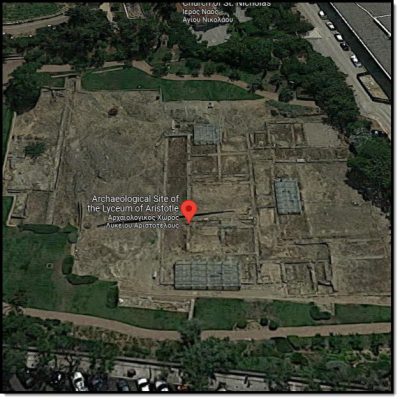
The Lyceum was a school founded by Aristotle in Athens, Greece, in 335 BCE. It was named after the Lyceum Grove, a public park where Aristotle and his students often gathered to discuss philosophy and other topics. The Lyceum was one of the most important centers of learning in the ancient world and was renowned for its intellectual rigor and diversity of subjects.
The Lyceum was established shortly after Aristotle left Plato’s Academy, where he had studied for nearly 20 years. Aristotle was eager to create his own school, one that would promote his own ideas and methods of teaching. The Lyceum was designed to be a place where students could come to learn about a wide range of subjects, including philosophy, science, politics, and ethics.
The Lyceum was organized around a central courtyard, with lecture halls, meeting rooms, and other facilities arranged around it. There were also gardens, a library, and a museum that housed a collection of natural specimens. Aristotle and his students would spend much of their time walking and talking around the grounds of the Lyceum, engaging in discussions and debates about various topics.
Aristotle’s teaching style at the Lyceum was characterized by a combination of lectures, discussions, and practical demonstrations. He believed in using examples and concrete illustrations to make his points, and he encouraged his students to ask questions and challenge his ideas. Aristotle saw himself as a guide and mentor to his students, rather than a strict authoritarian figure.
The Lyceum was also known for its emphasis on empirical observation and scientific inquiry. Aristotle believed that knowledge could only be gained through experience and that observation and experimentation were essential for understanding the natural world. His work in biology and other sciences greatly influenced the development of scientific thought in the centuries that followed.
After Aristotle’s death, the Lyceum continued to be a center of learning for many years. His successor, Theophrastus, continued to teach at the school and made significant contributions to the study of botany and natural history. Other notable figures associated with the Lyceum include Strato of Lampsacus, who succeeded Theophrastus as head of the school, and the philosopher and statesman Demetrius of Phaleron.
The Lyceum was eventually disbanded by the Roman Empire in the 1st century BCE, and the buildings and grounds were destroyed over time. However, Aristotle’s ideas and methods of teaching continued to be influential for centuries to come. The Lyceum served as a model for other schools and universities throughout history, and Aristotle’s legacy as a philosopher and educator has endured to this day.
In conclusion, the Lyceum was a school founded by Aristotle in Athens in the 4th century BCE. It was known for its intellectual rigor, diversity of subjects, and emphasis on empirical observation and scientific inquiry. The Lyceum was a center of learning that greatly influenced the development of Western thought and education, and Aristotle’s legacy continues to be studied and celebrated today.
Aristotle and Alexander the Great
Aristotle and Alexander the Great are two historical figures who are often associated with each other. Aristotle, a renowned philosopher, was Alexander’s tutor for several years, and the two developed a close relationship during that time.
Aristotle and Alexander the Great’s relationship began when Alexander’s father, King Philip II of Macedon, hired Aristotle to be Alexander’s personal tutor. Aristotle had a reputation as one of the most brilliant minds of his time, and King Philip believed that he could provide Alexander with a superior education.
During his time with Alexander, Aristotle taught him a wide range of subjects, including philosophy, literature, mathematics, and science. Aristotle also introduced Alexander to the works of Homer and other Greek authors, which helped to shape Alexander’s worldview and love of literature.
Despite their significant age difference, Aristotle and Alexander developed a close relationship during their time together. Aristotle was impressed with Alexander’s intelligence, and he recognized the young prince’s potential to be a great leader. For his part, Alexander admired Aristotle’s wisdom and knowledge, and he valued his tutor’s guidance and advice.
One of the most significant influences that Aristotle had on Alexander was in the area of ethics and morality. Aristotle’s teachings on virtue and the good life had a profound impact on Alexander, who strove to embody these ideals in his own life and leadership. Alexander was known for his sense of honor, his commitment to justice, and his generosity, all of which were values that he had learned from Aristotle.
Aristotle’s influence on Alexander was also evident in his military campaigns. Alexander was known for his strategic brilliance and his ability to inspire his troops, both of which were qualities that he had learned from Aristotle. Aristotle had taught Alexander the importance of using reason and logic to make decisions, as well as the importance of inspiring loyalty and courage in his soldiers.
Despite their close relationship, Aristotle and Alexander’s views on certain subjects were not always in alignment. For example, Aristotle was a pacifist who believed that war was a last resort and that it should only be waged in defense of one’s country. Alexander, on the other hand, was a conqueror who believed in expanding his empire through military conquest.
Despite these differences, Aristotle and Alexander’s relationship remained strong until Aristotle’s death in 322 BCE. After Aristotle’s death, Alexander continued to value his teacher’s wisdom and knowledge, and he reportedly carried a copy of Aristotle’s “Politics” with him on his military campaigns.
In conclusion, Aristotle and Alexander the Great’s relationship was one of the most significant partnerships in history. Aristotle’s teachings and guidance had a profound impact on Alexander, both as a leader and as a person. Their close relationship was based on mutual respect, admiration, and a shared love of knowledge and learning. Today, Aristotle and Alexander are remembered as two of the most influential figures in Western civilization, and their legacy continues to inspire and influence scholars and thinkers around the world.
Aristotle and the Peripatetics
The Peripatetics were a school of philosophers founded by Aristotle in the 4th century BCE. The name “Peripatetic” comes from the Greek word “peripatetikos,” which means “walking about.” This name was given to the school because Aristotle and his students were known for walking around the Lyceum in Athens while discussing philosophy.
The Peripatetics were known for their emphasis on observation and empirical evidence. They believed that knowledge could be gained through the senses, and they encouraged their students to use their own experiences to develop their understanding of the world. This approach to learning was in contrast to the more abstract and theoretical approach favored by other philosophical schools of the time.
The Peripatetics also placed great emphasis on logic and reasoning. Aristotle’s system of logic, which he developed in his work “Organon,” became the foundation of Western logic and reasoning. The Peripatetics believed that logic was the key to understanding the world, and they saw it as a necessary tool for developing sound arguments and making informed decisions.
In addition to their emphasis on observation and logic, the Peripatetics were also known for their interest in a wide range of subjects. Aristotle and his students studied everything from politics and ethics to biology and physics. They saw philosophy as a comprehensive discipline that encompassed all aspects of human knowledge.
The Peripatetics were also known for their commitment to teaching. Aristotle believed that it was the duty of philosophers to share their knowledge with others, and he established the Lyceum as a center of learning where students could come to study and learn from him and his students. The Lyceum became one of the most important centers of learning in the ancient world, and it attracted students from all over Greece and beyond.
After Aristotle’s death, the Peripatetic school continued to thrive under the leadership of his successors, Theophrastus and Strato. Theophrastus was known for his work in botany and his development of the field of natural history. Strato, on the other hand, was more interested in physics and was known for his work on the properties of matter and the nature of motion.
The Peripatetic school continued to be influential in the centuries that followed. Many of the great thinkers of the Middle Ages, such as Thomas Aquinas, were heavily influenced by Aristotle’s work and the Peripatetic school. Even today, Aristotle’s ideas continue to be studied and debated by philosophers and scholars around the world.
In conclusion, the Peripatetics were an important school of philosophers founded by Aristotle in the 4th century BCE. They were known for their emphasis on observation, logic, and a wide range of subjects. The Peripatetic school had a profound impact on Western philosophy and education, and it continues to be studied and celebrated today.
Aristotle’s Death
Aristotle died in 322 BC in the city of Chalcis on the island of Euboea, off the coast of Greece. Although his exact cause of death is unknown, there are a few theories and accounts of his final days.
According to one account, Aristotle was suffering from stomach illness in his final days, which may have been related to his old age. He was said to have been cared for by his wife, Herpyllis, and his close friend, Proxenus, who were both with him when he passed away. Another account suggests that Aristotle’s death was the result of natural causes, and that he simply died of old age.
The Loss and Rediscovery of Aristotle’s Works

During the Middle Ages, many of Aristotle’s works were lost or forgotten, only to be rediscovered centuries later. After Aristotle’s death in 322 BCE, his works were collected and preserved by his students and followers. However, as the Roman Empire fell and Europe entered the Middle Ages, many of these works were lost or destroyed.
In the early Middle Ages, Aristotle’s works were largely unknown in Europe, as the focus of intellectual life was on theology and the Bible. However, in the 12th century, a renewed interest in classical Greek philosophy led to the rediscovery of Aristotle’s works.
The rediscovery of Aristotle’s works was due in large part to the translation efforts of Muslim scholars. During the Islamic Golden Age, from the 8th to the 13th century, Muslim scholars translated many of Aristotle’s works into Arabic, and these translations were then brought to Europe by Jewish and Christian scholars.
One of the most important figures in the rediscovery of Aristotle’s works was the Spanish philosopher and theologian, Averroes. Averroes was a Muslim scholar who was deeply influenced by Aristotle’s ideas, and he wrote extensive commentaries on Aristotle’s works. His commentaries were translated into Latin and became hugely influential in medieval Europe.
Another important figure in the rediscovery of Aristotle’s works was the Italian scholar, Thomas Aquinas. Aquinas was a Catholic theologian who drew heavily on Aristotle’s ideas, incorporating them into his own theological works. Aquinas was instrumental in bringing Aristotelian philosophy into the Catholic intellectual tradition.
Despite the efforts of scholars like Averroes and Aquinas, many of Aristotle’s works remained lost or forgotten. However, in the 13th century, a group of scholars in Constantinople discovered a collection of Aristotle’s works that had been lost for centuries.
This collection, known as the Aristotelian corpus, contained many works that had been thought to be lost forever. The Aristotelian corpus included works on a wide range of topics, including metaphysics, ethics, politics, and natural science.
The rediscovery of the Aristotelian corpus had a profound impact on medieval Europe. It sparked a renewed interest in Aristotelian philosophy and led to a flowering of intellectual activity known as the Aristotelian revival. Aristotelian philosophy became the dominant intellectual framework of medieval Europe, and it continued to influence Western thought for centuries to come.
In conclusion, the disappearance and rediscovery of Aristotle’s works in the Middle Ages is a fascinating story of intellectual history. The rediscovery of his works was due in large part to the translation efforts of Muslim scholars, and it had a profound impact on medieval Europe. Today, Aristotle’s works continue to be studied and debated, and his ideas remain a vital part of the Western philosophical tradition.
Aristotle’s Influence on Catholicism

Aristotle’s impact on Catholicism cannot be overstated. His ideas and teachings have influenced many aspects of Catholic thought, from theology and ethics to natural science and metaphysics.
One of Aristotle’s most significant contributions to Catholicism was his philosophy of natural law. Aristotle believed that there is an objective, universal moral law that is inherent in the natural order of things. He argued that this law is discernible through reason and observation, and that it governs the behavior of all living things.
Catholic theologians have embraced this philosophy of natural law, incorporating it into their understanding of morality and ethics. The Catholic Church has long maintained that there are certain moral principles that are objective and universal, and that these principles are discernible through reason and observation.
Aristotle’s philosophy of natural law has also influenced Catholic teachings on social justice and the common good. Catholic social teaching emphasizes the importance of promoting the well-being of all people, especially the poor and marginalized. This commitment to social justice is rooted in the belief that all people have inherent dignity and worth, and that this dignity is grounded in the natural law.
Aristotle’s influence can also be seen in Catholic theology and metaphysics. His philosophy of causality and teleology, which holds that all things have a purpose and are directed toward a final end, has been integrated into Catholic teachings on the nature of God and creation. Catholic theologians have long argued that God created the world with a specific purpose and that all things are directed toward that purpose.
Furthermore, Aristotle’s emphasis on reason and empirical observation has been embraced by Catholic scholars throughout history. The Catholic Church has long held that faith and reason are complementary and that the study of the natural world can help to deepen our understanding of God’s creation.
In the Middle Ages, Catholic scholars such as Thomas Aquinas drew heavily on Aristotle’s ideas, incorporating them into their own theological and philosophical works. Aquinas, in particular, was instrumental in bringing Aristotelian philosophy into the Catholic intellectual tradition.
Today, Aristotelian philosophy continues to play an important role in Catholic thought and theology. The philosophy of natural law, in particular, remains a cornerstone of Catholic moral teaching, while the emphasis on reason and empirical observation continues to inform Catholic scholarship in fields ranging from theology to science.
In conclusion, Aristotle’s influence on Catholicism has been profound and enduring. His ideas and teachings have helped to shape many aspects of Catholic thought, from ethics and social justice to theology and metaphysics. As Catholic scholars continue to engage with Aristotle’s ideas, his legacy remains an important and vibrant part of the Catholic intellectual tradition.
Read Aristotle’s Works in the CLAA Library
The Classical Liberal Arts Academy’s online library includes Aristotle’s principal works, free to read. The first six make up the Organon, Aristotle’s logic.
- Categories
- On Interpretation
- Prior Analytics
- Posterior Analytics
- Topics
- Sophistical Elenchi
- Physics
- On the Soul
- Metaphysics
- Nicomachean Ethics
- Politics
- Rhetoric
Studying Aristotle in the Classical Liberal Arts Academy
Studying Aristotle’s works is an integral part of a classical Catholic education. Aristotle was one of the greatest philosophers of ancient Greece and his ideas have had a profound impact on Western thought, particularly in the areas of ethics, politics, and metaphysics. The Classical Liberal Arts Academy recognizes the importance of Aristotle’s works in the development of Catholic thought, and places a strong emphasis on the study of his philosophy.
The study of Aristotle’s works begins with his early works, such as the Categories and On Interpretation, which lay the foundation for his later philosophy. These works introduce key concepts such as substance, quality, and quantity, and provide a framework for understanding his later ideas. As students progress, they move on to more complex works, such as the Nicomachean Ethics and the Politics, which explore topics such as virtue, justice, and the nature of the state.
One of the key benefits of studying Aristotle’s works is that they provide a comprehensive understanding of the fundamental concepts that underpin Western thought. His works are a cornerstone of the classical tradition, and studying them provides a deep insight into the intellectual history of Western civilization. Moreover, his ideas continue to be relevant today, and provide a framework for understanding contemporary issues.
Studying Aristotle’s works also develops critical thinking skills. His works are complex and require careful analysis, interpretation, and evaluation. Students must learn to engage with his ideas critically, evaluating their strengths and weaknesses, and applying them to real-world scenarios. This develops analytical skills and the ability to think independently, which are essential in today’s rapidly changing world.
Another benefit of studying Aristotle’s works is that they provide a solid foundation for further study in the humanities and social sciences. His philosophy has had a profound influence on the development of Western thought, and many later thinkers, such as Thomas Aquinas and John Locke, drew heavily on his ideas. Studying his works provides a strong foundation for further study in fields such as philosophy, politics, law, and economics.
The Classical Liberal Arts Academy places a strong emphasis on the study of Aristotle’s works, and provides a comprehensive curriculum that covers his philosophy in detail. Students are introduced to his ideas through a variety of media, including readings, lectures, and discussions, and are encouraged to engage with his ideas critically. They are also encouraged to apply his ideas to contemporary issues, providing a practical context for their study.
In conclusion, studying Aristotle’s works is an integral part of a real classical education. His ideas have had a profound impact on Western thought, and studying his works provides a deep insight into the intellectual history of Western civilization. Moreover, his philosophy continues to be relevant today, and provides a framework for understanding contemporary issues. The Classical Liberal Arts Academy recognizes the importance of his philosophy, and provides a comprehensive curriculum that covers his works in detail, helping students develop critical thinking skills and a solid foundation for further study in the humanities and social sciences.
Mr. William C. Michael, Headmaster
Classical Liberal Arts Academy
Phone: (909) 281-7025
mail@classicalliberalarts.com
Not enrolled? Get started today for free!
The Classical Liberal Arts Academy works to research, restore, publish and teach the classical Catholic curriculum that has been enjoyed by wise men and saints through history. We invite you to study in our self-paced online courses and enjoy the benefits of online quizzes, written assignments, progress records and more. Get started with a free 30-day trial.
Students who wish to begin Aristotle’s logic under a teacher can join our live Logic 1A course, which begins in January 2027 with Porphyry’s Introduction to Aristotle’s Categories and continues with the Categories in the fall.
Questions about Aristotle
What is Aristotle best known for?
Aristotle is best known for founding formal logic and for writing systematic works on nearly every branch of learning: logic, natural science, the soul, metaphysics, ethics, politics, rhetoric and poetry. His philosophy became the foundation of the medieval schools, above all through the work of St. Thomas Aquinas.
Who did Aristotle teach?
Aristotle’s most famous student was Alexander the Great, whom he tutored at the request of King Philip II of Macedon beginning in 343 BC. Later, at his own school in Athens, the Lyceum, he taught many students, including Theophrastus, who succeeded him as head of the school.
When did Aristotle live?
Aristotle lived from 384 to 322 BC. He was a student of Plato, who was himself a student of Socrates, and he lived to see the conquests of his pupil Alexander.
What did Aristotle write?
About thirty of Aristotle’s treatises survive, including the Categories, Prior and Posterior Analytics, Physics, On the Soul, Metaphysics, Nicomachean Ethics, Politics, Rhetoric and Poetics. Most of these can be read in the CLAA Library.
Why do Catholics study Aristotle?
St. Thomas Aquinas and the Scholastic teachers used Aristotle’s philosophy as the natural foundation for the study of theology, and the Church has long commended their method, most notably in Pope Leo XIII’s encyclical Aeterni Patris (1879). To study Aristotle is to learn the language and reasoning of the Catholic intellectual tradition.